
Why Lost Deals and Quiet Customers Deserve a Second Look
Every business owner eventually runs into the same frustrating reality: not every lead converts, not every proposal gets approved, and not every customer stays active forever. For small to medium-sized businesses especially, those missed opportunities can feel expensive because they usually are. Time was invested, conversations happened, trust was partially built, and then somehow the deal stalled, the customer disappeared, or the relationship simply cooled off.
That is exactly where win-back campaigns come in.
At their core, win-back campaigns are structured efforts to reconnect with former customers, inactive accounts, or prospects who once showed interest but never moved forward. Instead of chasing only brand-new leads, businesses use these campaigns to reopen conversations with people who already know the brand, recognize the offer, and may simply need the right reason to re-engage. For founders, new business owners, entrepreneurs, account executives, and people just getting started in sales, this matters because it shifts the mindset from “start from zero” to “build from what already exists.”
That is a powerful advantage. Acquiring new customers is often more expensive and slower than re-engaging people who have already interacted with your business. A smart win-back strategy allows you to recover hidden revenue, shorten sales cycles, improve marketing efficiency, and strengthen your overall pipeline. More importantly, it helps you see your CRM, email list, and old opportunities not as dead ends, but as assets that may still have value.
In a business environment where attention is limited and competition is constant, win-back campaigns are not just a nice extra. They are a practical growth strategy for companies that want to make the most of the opportunities they have already earned.
What Win-Back Campaigns Actually Mean
When people hear the phrase win-back campaigns, they often think only of former customers who canceled or stopped buying. That is one part of it, but the idea is broader than that. A win-back campaign can target several groups: customers who have gone inactive, prospects who asked for a quote but never replied, buyers who chose a competitor, or clients who once purchased and then disappeared over time.
The common thread is simple. These are people or businesses that were once close enough to your brand to matter.
That is what makes win-back campaigns so valuable. You are not introducing yourself to a completely cold audience. You are re-entering a conversation that already started at some point. Maybe the timing was wrong. Maybe the budget was not there. Maybe priorities shifted. Maybe they forgot. Maybe your offer was not strong enough back then, but it is now. A win-back campaign gives you a structured way to test whether that opportunity is truly gone or simply dormant.
For newer sales professionals, this is especially important to understand. “No” does not always mean “never.” In many cases, it means “not now,” “not this version,” or “not under these circumstances.” A well-timed follow-up months later can produce results that seemed impossible during the original sales cycle.
Why Win-Back Campaigns Matter More Than Many Businesses Realize
One of the biggest mistakes growing businesses make is over-focusing on lead generation while underusing their existing contact base. New leads are exciting because they feel like forward motion. But old leads, past clients, and inactive buyers often represent lower-friction opportunities because some awareness and trust already exist.
This is where win-back campaigns shine. They allow businesses to improve return on previous effort. Every proposal sent, demo given, discovery call held, and first purchase completed created a level of familiarity. That familiarity has value. If you ignore it, you leave revenue sitting idle in your pipeline history.
For SMB owners and founders managing lean budgets, this is more than a sales tactic. It is a resource-efficiency strategy. Instead of spending all your time and budget trying to generate brand-new attention, you can use win-back campaigns to revive interest from people who already know what you do. That can reduce acquisition costs and create faster paths to conversion.
There is also a brand perception benefit. Reaching back out thoughtfully shows consistency. It communicates that your business is attentive, organized, and genuinely interested in helping, not just in closing one-time transactions. If done well, a win-back message can feel less like a sales push and more like a timely check-in.
The Real Business Benefits of Win-Back Campaigns
The most obvious benefit of win-back campaigns is revenue recovery. Businesses often have more recoverable revenue in their inactive database than they think. Former customers may need a new service cycle, a better plan, a fresh product version, or simply a reminder that you exist. Lost prospects may now have a budget, a new team, or a stronger need than when you first spoke.
But revenue is only one layer.
Win-back campaigns also improve sales efficiency. Re-engaging an old opportunity is often faster than educating a brand-new lead from the ground up. The buyer may already understand your category, remember your pricing range, or recognize your name from previous conversations. That shortens the path to a meaningful conversation.
They also produce stronger insights. When you reconnect with lost opportunities, you learn why people left, why they delayed, or what changed. That feedback is incredibly useful for refining offers, pricing, onboarding, positioning, and follow-up timing. In other words, win-back efforts can improve both current revenue and future strategy.
For account executives and SDRs, there is another major benefit: confidence. Working old opportunities can create quick wins, especially for people early in their sales careers. It teaches follow-up discipline, segmentation, messaging, objection handling, and timing, all within a warmer audience than a fully cold outbound list.
What Makes a Win-Back Campaign Work
Successful win-back campaigns are not random “just checking in” emails blasted to everyone in your database. They work best when they are intentional, segmented, and relevant.
The first key factor is timing. A customer who stopped buying three weeks ago needs a different message than one who has been inactive for twelve months. A prospect who ghosted after a demo should not receive the same message as a former client who left because of budget constraints. Good win-back campaigns recognize where the contact is in their relationship history and tailor the outreach accordingly.
The second factor is relevance. The message should answer a simple question: Why should this person care now? That reason could be a new feature, updated pricing, a seasonal need, a solved pain point, a limited-time offer, or a fresh business development. The point is not to say, “We are following up.” The point is to say, “Here is why reconnecting today could be valuable for you.”
The third factor is tone. The best win-back campaigns sound human, respectful, and confident. They do not guilt people for leaving, and they do not overwhelm them with hard-selling language. They acknowledge the past relationship and make re-entry easy. In many cases, the strongest message is short, clear, and useful.
Segmentation Is the Difference Between Noise and Results
If there is one feature that consistently separates mediocre win-back campaigns from effective ones, it is segmentation.
Not all lost opportunities are the same. Some customers churned because they were unhappy. Others left because they no longer needed the product. Some prospects were interested but went silent. Others actively chose a competitor. Treating all of them as one audience usually leads to weak messaging and poor response rates.
A better approach is to group contacts based on behavior and context. You might segment by:
- Former customers who have not purchased in 3, 6, or 12 months
- Prospects who requested pricing but never closed
- Accounts lost to “bad timing”
- Clients who left due to budget concerns
- Customers who purchased once but never returned
Each segment deserves a slightly different re-entry strategy. Budget-sensitive contacts may respond well to a lighter offer or revised package. Former customers may care more about what has improved since they last engaged. Lost deals may need a message built around timing, priorities, or new use cases.
This level of segmentation makes win-back campaigns more personal without making them complicated. Even simple segmentation can dramatically improve response quality because the outreach feels specific rather than generic.
Messaging That Reopens Conversations
The best win-back campaigns do not try to restart the relationship by pretending nothing happened. They work because they acknowledge the past and provide a reason to reconnect now.
That message might sound like this in principle: We spoke a while back about this challenge. A lot has changed since then, and I thought it might be useful to reconnect because we have improved X, added Y, or are helping companies like yours solve Z more effectively.
Notice what that does. It respects history, introduces relevance, and invites conversation without pressure.
For former customers, strong messaging often includes one of three elements: improvement, simplicity, or value. Improvement means showing what is better now. Simplicity means making it easy to restart. Value means giving a real reason to return, whether through service enhancements, updated support, better onboarding, or a well-framed incentive.
For lost prospects, the most effective messages usually focus on changed circumstances. Maybe the market shifted. Maybe your solution matured. Maybe the contact’s business is growing and the problem has become more urgent. Win-back campaigns perform better when they connect your outreach to a believable current need.
Channels and Cadence: More Than One Follow-Up
Email is often the backbone of win-back campaigns, but it should not always be the only channel. Depending on your audience, a thoughtful multi-touch approach can perform much better. That may include email, phone calls, LinkedIn outreach, retargeting ads, SMS for suitable businesses, or even direct mail in higher-value account strategies.
The cadence matters too. One email is rarely a campaign. A true win-back sequence usually includes multiple touches spaced over a defined period. The goal is not to overwhelm people, but to give them more than one chance to respond when timing is right.
A simple campaign might begin with a reintroduction email, followed by a value-focused follow-up, then a softer check-in, and finally a last-touch message that leaves the door open. What matters most is consistency and clarity. Every touch should feel connected and intentional.
For business owners wearing multiple hats, this is where systems matter. A CRM, even a basic one, can help you track inactivity, set triggers, and automate parts of your win-back campaigns so opportunities do not slip away unnoticed.
Common Mistakes That Undermine Win-Back Campaigns
Many win-back campaigns fail not because the idea is flawed, but because the execution is careless.
One common mistake is contacting everyone with the same message. That usually leads to low engagement because it ignores the real reasons people disengage in the first place. Another mistake is focusing too heavily on discounts. Incentives can help, but if every win-back effort is just a price cut, you may train your audience to wait for offers rather than value the relationship.
Another frequent issue is poor timing. Businesses often either reach out too soon, before the customer has had space, or far too late, after the opportunity has truly gone cold. There is also the problem of weak data. If your CRM notes are inconsistent or outdated, your win-back campaigns will be harder to personalize and prioritize.
Finally, some businesses give up too quickly. Not every contact will respond on the first touch, and not every win-back campaign becomes an immediate sale. Sometimes the result is reactivation later, referral interest, valuable feedback, or a reopened conversation that enters the pipeline again. That still matters.
How to Build a Practical Win-Back Strategy
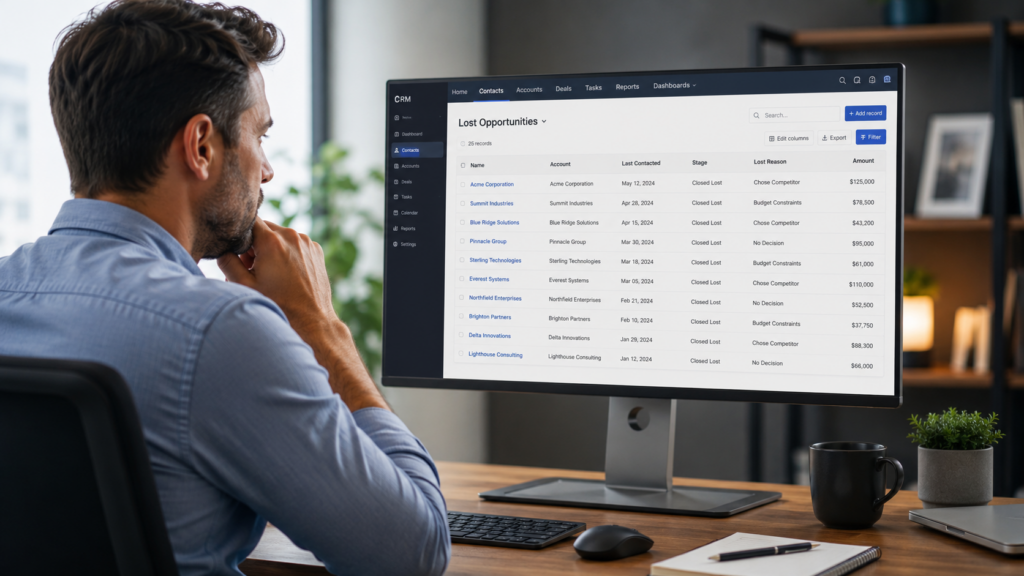
For most businesses, a strong win-back strategy starts with identifying which groups represent the best re-engagement potential. Start by looking at your existing database. Who purchased before but stopped? Which deals reached the proposal stage and then stalled? Which prospects said “circle back later”? Those are prime candidates for win-back campaigns.
Next, define your segments and build simple messaging for each one. Keep the outreach relevant and concise. Then decide on the cadence and channels you will use. You do not need a highly complex system to begin. Even a short email sequence and a few targeted calls can create results if the messaging is clear.
Measurement is also important. Track open rates, replies, meetings booked, reactivated accounts, and recovered revenue. Over time, these metrics will show which messages, offers, and timing windows work best. That turns win-back campaigns from a one-off experiment into a repeatable growth engine.
For newer founders and sales reps, the biggest takeaway is this: your closed-lost list and inactive customer base are not just records of failure. They are maps of unfinished opportunity.
FAQ: Win-Back Campaigns
1. What are win-back campaigns in simple terms?
Win-back campaigns are targeted efforts to reconnect with former customers, inactive clients, or lost prospects in order to restart the relationship and recover business opportunities.
2. Who should use win-back campaigns?
They are useful for small business owners, founders, entrepreneurs, sales teams, account executives, and service providers. Any business with past customers or stalled leads can benefit from a structured re-engagement strategy.
3. When is the best time to launch win-back campaigns?
The best timing depends on the audience. Some businesses run win-back campaigns after 30, 60, or 90 days of inactivity, while others use longer timelines for higher-value or slower-moving sales cycles.
4. Should win-back campaigns always include discounts?
No. Discounts can help in some cases, but they should not be the default. Many win-back campaigns perform well by highlighting improvements, new features, better service, or a renewed business need rather than lowering price.
5. How do I know if a win-back campaign is successful?
Success can be measured through reply rates, meetings booked, reactivated customers, recovered revenue, and renewed engagement. Even if not every contact converts immediately, reopened conversations and useful feedback are valuable outcomes.