
If you’re a founder, small to medium-sized business owner, entrepreneur, AE stepping into a player-coach role, or someone just getting started in sales development, you’ve probably felt the same pain: hiring an SDR takes time and money, and then the ramp feels slow and messy. Weeks go by, and you’re still wondering, “When will this new SDR actually start filling the pipeline?”
That’s where a structured SDR onboarding process becomes a serious competitive advantage. Instead of hoping a new hire “figures it out,” you give them a clear, step-by-step path to productivity. The result: faster ramp times, more consistent performance, and far less stress—for both leadership and the SDR.
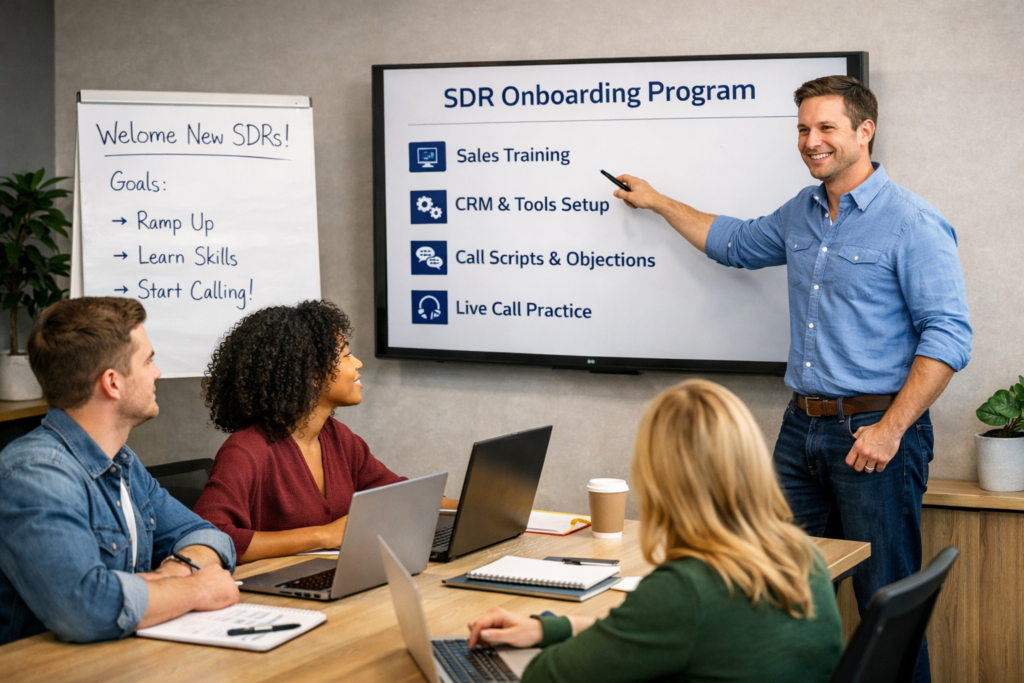
In this post, we’ll walk through a practical, detailed SDR onboarding checklist for faster ramp. It’s designed for small and mid-sized teams that don’t have a massive enablement department, but still want the rigor and results of a top-tier sales organization. We’ll cover what to prepare before your SDR’s first day, what to focus on in the first 30–60 days, how to measure progress, and how to keep your SDR onboarding process improving over time.
What Is SDR Onboarding and Why It Matters
At its core, SDR onboarding is the structured process of getting a new sales development rep from “day one” to “reliably generating qualified pipeline.” It’s not just explaining where the CRM is or sharing a few call scripts. Done well, SDR onboarding covers knowledge (your market, product, ICP), skills (prospecting, cold calling, writing outreach), and systems (tools, workflows, handoffs).
For small and medium-sized businesses, this matters even more than it does at big enterprises. Every headcount is a bigger percentage of your team, and every month of slow ramp hurts. A single underperforming SDR can be the difference between hitting your growth targets and missing them.
A clear SDR onboarding checklist:
- Shortens time-to-first-meeting and time-to-quota
- Makes performance expectations transparent and fair
- Reduces the “sink or swim” feeling new reps often have
- Helps founders and AEs stop reinventing the wheel with every new hire
Instead of fuzzy ramp plans like “shadow for a bit and then start making calls,” you’re creating an actual system—one you can repeat, measure, and improve.
Core Principles of Effective SDR Onboarding
Before we dive into the detailed SDR onboarding checklist, it’s worth aligning around a few guiding principles. These will help you make smart tradeoffs even if you can’t implement every single suggestion right away.
1. Clarity beats volume.
New SDRs don’t need 200 pages of documentation on day one. They need clarity on what success looks like, what their ramp targets are, and what they should focus on this week. Think “less information, more direction.”
2. Practice over theory.
You can talk about prospecting theory for hours, but SDR onboarding only works when reps start doing the actual work: writing emails, making calls, leaving voicemails, and handling objections. Build practice into the process early.
3. Gradual exposure, not immediate overload.
A good SDR onboarding plan introduces complexity in stages. First, they learn your ICP and basic messaging. Then they start with emails. Then calls. Then live call blocks. This layered approach builds confidence and skill at the same time.
4. Coaching is not optional.
Even the best checklist fails if there’s no feedback loop. SDR onboarding should bake in coaching from managers, senior SDRs, or AEs—via call reviews, email reviews, and short weekly 1:1s focused on skill-building, not just numbers.
5. Consistency with room for personalization.
You want a consistent SDR onboarding framework so every new hire gets the same core experience. But you also want space to tailor ramp based on experience level, territory, and learning style.
The SDR Onboarding Checklist for Faster Ramp
Let’s break down a practical SDR onboarding checklist into clear stages. You can treat these as templates and adjust the timelines based on your business and deal cycle.
Stage 0: Pre–Day 1 Setup
Fast ramp starts before your SDR logs into their laptop.
At a minimum, your SDR onboarding prep should include:
- Access to all tools: CRM, sequencing/prospecting tool, email, calendar, calling software, chat, and any data providers.
- A short “welcome pack” that outlines your mission, product, target customers, and how the SDR role impacts revenue.
- Their scorecard and ramp plan: activity metrics, pipeline goals, and expected milestones for 30, 60, and 90 days.
By taking care of this upfront, your SDR’s first day is about learning and engaging—not chasing logins or asking, “Who do I talk to about CRM access?”
Stage 1: Week 1 – Foundations
The first week of SDR onboarding should be about orientation, context, and basic competence.
Focus on four pillars: company, customer, product, and process.
First, help them deeply understand who you sell to and why they buy. Walk them through your ICP, ideal account profile, key personas, and their typical pains. Show real examples of current customers, the problems you solved, and the outcomes they achieved. This makes all future outreach more meaningful and less robotic.
Next, give them a tight product overview—not just a feature tour, but how your product or service solves those pain points. Record a few strong demos or invite them to sit in on live ones with AEs. Their goal isn’t to become a full product expert yet, but to understand enough to have credible top-of-funnel conversations.
Alongside this, introduce your SDR process and tools: how to log activities in the CRM, how you define an MQL versus an SQL, how meetings are booked and handed off to AEs, and what a “qualified meeting” looks like in your world. Show them your sequences, templates, and cadences, and explain the thinking behind each.
By the end of Week 1, a well-designed SDR onboarding plan should have them:
- Comfortable navigating your CRM and core sales tools
- Able to explain what your company does and who you help
- Clear on their ramp expectations and how they’ll be measured
They may only be doing light prospecting at this stage, but the foundation is set.
Stage 2: Weeks 2–3 – Skills, Scripts, and Prospecting
Once the basics are in place, the next part of SDR onboarding is about building hands-on skills in outreach and qualification.
Start with written outreach. Have your SDR write their own versions of outbound emails using your core messaging as a base. Review and edit these together. Show them examples of effective subject lines, openers that reference the prospect’s world, and calls-to-action that fit your motion (e.g., booking a discovery call, short intro chat, or sending a resource).
Then shift into calling skills. Many new SDRs find cold calling intimidating, especially if they’re early in their careers. Role play is your best friend here. Run multiple call simulations: basic intros, objection handling, voicemails, and short discovery. Use realistic scenarios based on your actual accounts and personas.
During this period, gradually ramp their live activity:
- Start with a small daily target for emails and calls, then increase each week.
- Assign them “safer” accounts or segments initially, while they build confidence.
- Have them join call blitz sessions with a manager or experienced SDR who can jump in and support.
Crucially, make sure SDR onboarding in these weeks includes structured feedback. Do quick call reviews: listen to two or three calls together and identify what worked and what needs improvement. Do the same with email replies and campaigns. This tight loop is what turns theory into performance.
By the end of Week 3, most SDRs—especially those with some prior experience—should be:
- Running full outbound sequences on their own
- Comfortable making live dials and leaving professional voicemails
- Handling basic objections and knowing when to bring in an AE
Stage 3: Weeks 4–6 – Live Fire and Optimization
In this phase of SDR onboarding, the rep moves from “training mode” to real ownership of a territory or segment, with support.
Their daily and weekly activity cadence should now be close to that of a fully ramped SDR, even if their targets are slightly lower while they build muscle. You can set a clear ramp path such as:
- Week 4: 70% of full activity targets
- Week 5: 85–90%
- Week 6+: Full target
Alongside the activity ramp, this is where you deepen qualification skills. Teach them what makes an opportunity worth passing to an AE in your specific context. Maybe it’s budget and timeline; maybe it’s tech stack fit, use case, and team size. Listen to live or recorded calls and highlight the questions that matter most.
This is also the right time in SDR onboarding to introduce territory strategy and a bit of autonomy. Instead of just handing them lists, teach them how to:
- Build their own target lists based on your ideal customer profile
- Prioritize accounts by fit and urgency
- Layer in triggers like hiring, funding, new locations, or tech changes
You want them thinking, not just following a script.
By the end of this stage, a strong SDR onboarding process will have the rep:
- Fully running their territory or account list
- Consistently booking meetings that AEs consider high quality
- Hitting ramped activity and early pipeline/meeting targets
At this point, onboarding blends into ongoing development, but the heavy lifting is done.
What to Include in Your SDR Onboarding Materials
Your checklist is the “what” and “when.” The materials are the “how.”
A robust SDR onboarding program doesn’t require fancy software, but you should centralize a few key assets so they’re easy to find and update.
First, create a concise SDR handbook or playbook. This doesn’t need to be a novel. Even a 15–30 page document that covers your ICP, personas, messaging frameworks, qualification criteria, and process is a massive step up from ad hoc training. Link out to call recordings, email templates, and battlecards.
Second, build a small library of call recordings—both great and average. New SDRs should hear what “good” sounds like, but it’s also useful to analyze real-world calls where things were messy or imperfect. Annotate a few calls with commentary: why certain questions were strong, where the SDR could have dug deeper, how they handled objections.
Third, provide template packs as starting points, not scripts to read word-for-word. Give them outbound email frameworks, openers, objection responses, and talk tracks. Encourage them to personalize and adapt within clear guardrails, so your SDR onboarding still produces consistent messaging without turning reps into robots.
Finally, set up a simple learning path: a checklist or tracker that shows what they should complete and by when—watch X recordings, read Y sections, pass Z mock call, etc. This gives both you and the SDR a shared view of progress.
Measuring SDR Onboarding Success
If you want SDR onboarding to consistently drive faster ramps, you need to measure more than just “did they hit quota by Month 3.”
Think about leading and lagging indicators.
Leading indicators might include:
- Time to first meeting booked
- Time to first qualified meeting
- Number of calls, emails, and meaningful conversations by week
- Completion of training modules, role plays, and certifications
Lagging indicators include:
- Qualified meetings per month
- Conversion from meeting to opportunity
- Pipeline generated versus ramp targets
For small and mid-sized teams, a simple dashboard or sheet is enough. The key is to compare new SDRs against the same SDR onboarding benchmarks, not against a vague mental model of “how fast people usually ramp.”
Use these metrics not just to judge individual performance, but to improve your overall process. If many new SDRs are slow to book their first meeting, maybe you’re delaying live calls too long. If they’re booking a lot of meetings that don’t convert, you may need to clarify qualification standards in your SDR onboarding materials.
Common SDR Onboarding Mistakes to Avoid
Even the best-intentioned teams fall into predictable traps when it comes to SDR onboarding.
One common mistake is information dumping. You cram every bit of company history, product nuance, and sales theory into the first week. The SDR retains 10 percent, gets overwhelmed, and struggles to remember what matters when they’re actually talking to prospects.
Another is lack of clear ownership. No one is truly responsible for SDR onboarding, so different people “drop in” with random training sessions. New hires get mixed messages and conflicting advice. Assign a primary owner—often the SDR manager, sales leader, or a senior SDR—and make them responsible for the end-to-end experience.
A third mistake is jumping straight to full quota and pressure. You hire an SDR, give them logins and a target, and hope for the best. When they miss early, confidence erodes on both sides. Instead, use ramped expectations and focus on behaviors—activity, learning milestones, and quality of conversations—before going all-in on full quota.
Finally, teams often fail to update their SDR onboarding process. Markets change, product evolves, messaging shifts, but the original playbook stays frozen. Treat onboarding as a living system: collect feedback from every new SDR, review outcomes quarterly, and adjust.
Turning SDR Onboarding into a Living Playbook
The most effective teams treat SDR onboarding as a continuous improvement loop, not a one-time project.
Start simple. Document your current process, even if it’s rough. Run your next one or two hires through it, and ask them what was helpful, what was confusing, and where they felt stuck. Pay attention to patterns. If every new SDR is confused about handoff criteria or your ICP, that’s a signal to clarify those sections.
Involve your top performers. Have high-performing SDRs and AEs contribute call recordings, email examples, and tips. Invite them to run parts of onboarding: a live session on objection handling, a teardown of real email threads, or an office-hours session in Week 2. This not only levels up new hires but reinforces best practices across the team.
Finally, make it easy to maintain. Keep your checklist and core SDR onboarding materials in a shared, version-controlled location—whether that’s a simple internal doc, wiki, or sales enablement tool. When you change your outbound strategy or launch a new product, updating onboarding becomes a small, natural step instead of a massive rewrite.
SDR Onboarding FA1. How long should SDR onboarding take?
Most teams see solid results with a structured SDR onboarding program that runs for 30–60 days. In the first 2–3 weeks, the focus is on foundations, practice, and early activity. By weeks 4–6, the SDR should be close to full activity levels and generating a meaningful pipeline. Some complex products or enterprise motions may require a longer ramp, but the key is to define clear milestones at 30, 60, and 90 days rather than relying on a vague “they’ll get there eventually.”
2. What should a new SDR be doing in their first week?
During the first week of SDR onboarding, the rep should be learning your company, ICP, product value props, and core process, while getting comfortable with your tools. They should shadow live calls, watch recorded demos, and review example emails and sequences. Light prospecting tasks—like researching accounts, drafting emails, or sending a small number of messages—can start toward the end of the week to build early confidence.
3. How do I know if my SDR onboarding is working?
You’ll know SDR onboarding is working if new hires reach key milestones faster and more consistently. Look for shorter time to first meeting, earlier production of qualified meetings, and steady improvement in call and email quality during the first 4–6 weeks. If multiple reps hit similar ramp goals on a similar timeline, that’s a strong sign your process is effective. If results are inconsistent, it’s a cue to refine your checklist, materials, or coaching.
4. What tools do I need to support SDR onboarding?
You don’t need an expensive tech stack to run solid SDR onboarding. At minimum, you need a CRM, a way to record and review calls, and a place to store your playbook and materials. A sequencing or outbound tool is extremely helpful for structuring outreach. Beyond that, simple documentation and regular coaching sessions often matter more than any specific tool.
5. How should SDR onboarding differ for experienced versus junior reps?
For experienced reps, SDR onboarding can move more quickly through basic concepts and spend more time on your specific product nuances, ICP, and process. You might give them ownership of a territory faster and raise ramp targets sooner. For junior reps or those new to sales, build in more time for role plays, live practice, and foundational skills like call confidence and objection handling. The framework can be the same, but the depth and pacing should match their background.